Introduction: AI-Driven CNC Machining in Manchester
AI, automation, and Industry 4.0 are reshaping the manufacturing landscape, and manchester precision engineering is at the forefront of this shift. Manchester houses one of the UK’s largest concentrations of advanced manufacturing companies, and firms like Elmax Engineering Ltd-based in Stockport and founded in 2003-are embracing these technologies to deliver faster, smarter, and more reliable cnc machining services. Our core services span CNC milling, CNC turning, Cylindrical grinding services, and keyway slotting, producing custom parts for both one-off prototypes and high volume production runs. Customers across food, medical devices, construction, and automotive industries now expect high quality components backed by digital traceability and tight deadlines. This article explores how we got here, where the technology is heading, and what it means for manufacturers and OEMs across Greater Manchester and the UK.
From Manual Machining to Smart CNC: How We Got Here
The journey from manual milling machines and lathes to today’s intelligent cnc machining centres spans decades of incremental development.
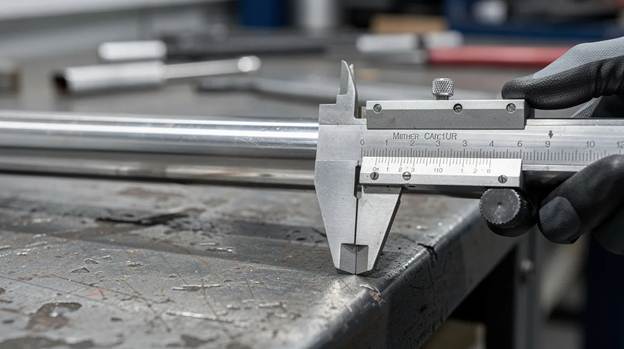
In the 1980s and 1990s, precision depended almost entirely on the machinist’s skill-manual lathes, hand-cranked feeds, and vernier calipers set the pace. Repeatability was limited. Complex part design meant long hours and high scrap rates. The introduction of CNC changed the direction entirely: cnc machining uses computer-controlled machines for precision manufacturing, removing much of the human variability from the production process.
By the early 2000s, CAD/CAM software had matured enough to generate optimised toolpaths automatically. Manchester firms now utilize 3, 4, 5, and 7-axis CNC systems linked to CAD/CAM, enabling the kind of complexity that was simply impossible on a 2-axis machine tool. Multi-axis cnc brought the ability to cut undercuts, compound angles, and irregular surfaces in a single setup, improving both accuracy and efficiency.
Elmax Engineering Ltd entered the industry at exactly this inflection point. Since 2003, we have progressively invested in cnc turning centres, vertical machining centres, and digital inspection equipment, evolving alongside the technology our customers depend on.
Core CNC Machining Services in Manchester Today
CNC turning and milling are core capabilities among Manchester’s precision engineering companies, and Elmax Engineering is no exception. Our range of cnc machining services covers everything from simple bushings to intricate housings and precision shafts. CNC machining processes include turning, milling, and grinding-each chosen to match the geometry, material requirements, and tolerances of the component.
Precision engineering in Manchester focuses on high-end large-scale cnc machining, and many manufacturers in the region support both prototype and high volume production components. CNC machining is suitable for both low-volume prototypes and high-volume production, making it a versatile manufacturing process for companies across multiple industries.
CNC Milling and Multi-Axis Machining
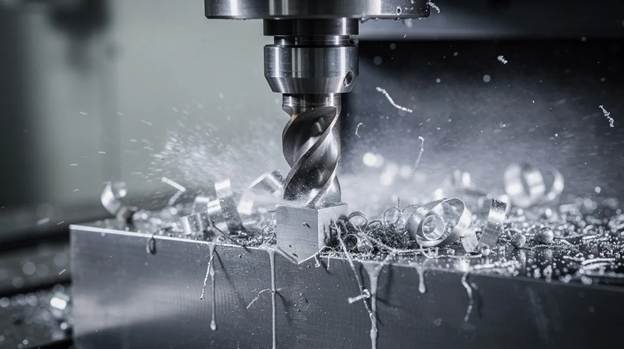
CNC milling uses computer-controlled machines for precision part manufacturing, removing material with rotary cutters guided by programmed toolpaths. CNC milling machines can operate on 3, 4, or 5 axes. While 3-axis machines are the most common type of CNC mills-handling flat surfaces, pockets, and slots-5-axis machines can create highly complex designs like medical implants, turbine blades, and intricate housings.
At Elmax, our vertical machining centres with 4th-axis rotation fixtures produce components for food processing equipment, medical housings, and automotive brackets. CNC milling can produce parts with dimensions up to 2000 x 750 x 600 mm, and large-format machining envelopes are available for producing complex components in Manchester. We mill stainless steel (304, 316), aluminium grades like 6082 and 7075, mild steel, and engineering plastics such as acetal and PEEK. CNC milling is used in automotive, aerospace, and medical industries, and it can produce high and low volumes of intricate parts with consistent surface finish-typically Ra 0.8–1.6 μm.
CAM software already provides a first stage of automation before AI enters the picture, optimising toolpaths to extend tool life and reduce cycle times on every cnc machining project.
CNC Turning and Complex Shafts
CNC turning is ideal for cylindrical machined components-shafts, bushings, threaded connectors, and cones-serving construction and automotive customers across Greater Manchester. CNC turning uses fixed and sliding head lathes for precision, and modern machines feature driven tooling, bar feeders, and digital controls that support both small batch and repeat high volume orders.
CNC turning can produce components from 1mm to 250mm diameter, handling everything from miniature pins to substantial drive shafts. CNC turning is suitable for complex high precision components, and CNC turning can handle both prototypes and large-scale production with equal reliability. At Elmax, we combine cnc turning with secondary operations-cylindrical grinding for bearing-fit surfaces and keyway slotting for drive assemblies-to deliver finished, ready-to-assemble high quality parts.
AI and Automation on the Shop Floor
When we talk about AI and automation in a cnc context, we mean more than robotic arms. It is software intelligence applied to feeds, speeds, toolpath selection, and real-time process monitoring. Increased adoption of automation characterizes recent advancements in Manchester’s precision engineering, and a 2026 industry analysis identifies AI-driven adaptive control as one of the five major trends reshaping cnc machining this year.
AI-driven CAM tools now help our team choose cutting strategies for cnc milling and cnc turning that avoid chatter, reduce tool wear, and improve surface finish. Automated probing on axis cnc machines measures features between operations, catching drift before it becomes scrap. The result is fewer rejected parts, better production capacity, and more predictable lead times for our clients.
At Elmax, we use automation to enhance human decision-making, not replace it. Our machinists bring the depth of experience needed to interpret data, adjust parameters, and ensure every component meets specification.
Smarter Programming and Toolpath Optimisation
AI-enhanced CAM software analyses previous jobs and recommends cutting strategies that reduce cycle time and extend tool life-particularly on hard materials like 316L stainless or titanium. Simulation and digital verification happen before the job reaches the milling machine, minimising on-machine trial-and-error and downtime.
Better toolpaths translate directly into competitive cost and faster delivery. For customers in food processing or automotive, this means high quality results on repeat orders without the price creep that comes from inefficient programming.
Automated Handling and Lights-Out Machining
Lights-out machining refers to extended unattended runs-bar feeders on cnc lathes, pallet systems, or multi-vice workholding on cnc milling machines running overnight. High-volume production can increase output by five-fold with automation, and CNC machining is capable of high-volume production with consistent quality when the process is proven.
Elmax Engineering selectively applies this approach on stable, validated jobs where process capability is confirmed. The benefit for customers: consistent quality on high volume orders, efficient turnaround, and competitive unit pricing without compromising inspection standards.
Industry 4.0 and Connected Precision Engineering
Industry 4.0 combines connectivity, data, and automation into a single manufacturing ecosystem. For a precision engineering firm in Manchester, this means every machine on the shop floor can feed live data into planning and quality systems.
Machine connectivity allows monitoring of spindle uptime, job progress, and overall equipment effectiveness. Production data refines quoting, capacity planning, and preventive maintenance at Elmax Engineering, improving reliability for customer delivery schedules. Even smaller companies can implement practical steps: digital job cards, barcoded tooling, live job tracking, and electronic quality records.
Real-Time Monitoring and Data-Driven Decisions
On our shop floor in Stockport, dashboards display spindle status, alarms, and job progress across milling and turning centres. This data helps identify bottlenecks, under-utilised machines, or recurring issues related to specific operations or materials.
A concrete example: using vibration and load trends to schedule tool replacement on a particular machine before failure avoids unplanned downtime on a critical medical devices order. For customers, this means more predictable lead times, better communication on job status, and lower risk of unexpected delays.
Digital Twins and Virtual Prototyping
A digital twin is effectively a virtual cnc machining cell-a CAD/CAM model combined with process simulation that lets engineers verify part design, fixture strategies, and toolpaths before cutting metal. This is especially useful for complex custom parts and tight-tolerance medical or food-contact components, where changes are expensive once production starts.
Elmax Engineering works collaboratively with customers’ design teams to refine models for machinability, cost, and performance at an early stage, using these digital tools to support development and reduce risk.
AI-Ready Materials, Sectors and Applications
The impact of AI and automation varies by material and sector. CNC machining can produce parts from various materials including metals and plastics, and advanced materials research in Manchester focuses on lightweight structural materials and nanomaterials-pushing what can be machined on modern equipment. The aerospace and automotive sectors are primary focuses for Manchester’s precision engineering, while precision engineering in Manchester supports a wide range of industries including aerospace and medical.
Material-specific databases and AI-driven recommendations assist with machining stainless steel for hygienic environments, aluminium for lightweight structures, and plastic components for specialist applications. Elmax can machine almost any material our customers specify, from exotic alloys to engineering polymers.
Medical Devices and Regulated Industries
Medical devices and other regulated sectors demand traceable, precision machined components and rigorous process control. CNC milling and CNC turning services produce housings, fixtures, and surgical-instrument components from grades like 316L stainless and titanium (Ti-6Al-4V). Digital quality records, inspection reports, and controlled processes support compliance with standards such as ISO 13485 and ISO 10993.
In-process measurement, CMM inspection, and documented toolpaths achieve the repeatability required on multi-batch, multi-year medical components-where tolerances of ±0.005 mm on critical features are not unusual.
Food, Construction and Automotive Components
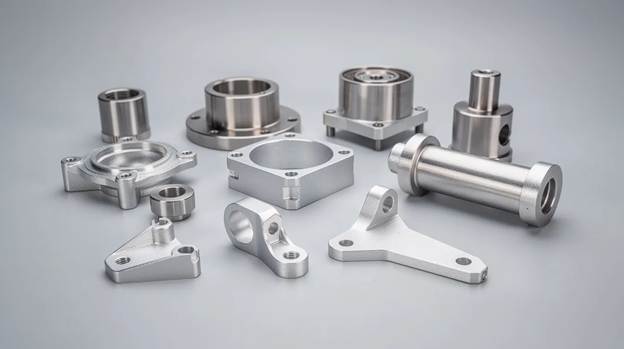
Typical cnc machined parts for food production machinery include shafts, guards, and brackets in 304 or 316 stainless with polished finishes. Construction applications cover anchors, fixings, and load-bearing brackets, while automotive work spans housings, bushings, and drive components.
AI-optimised machining strategies allow cost-effective production of both prototypes and high volume repeats. On one recent project, switching to trochoidal milling on a batch of food-grade stainless housings cut cycle time by 30% and extended tool life by 40%-a direct saving passed on to the customer with no compromise on detail or surface quality.
Quality Assurance in the Era of Smart Machining
Automation and AI only deliver value when combined with strong quality assurance. Quality is fundamental in safety-critical industries like train braking systems, and this principle applies equally across food, medical, and automotive sectors. Manchester’s precision engineering often features advanced inspection technologies for quality assurance, and firms like Hemlock Engineering use advanced inspection equipment to guarantee quality across their output.
At Elmax Engineering, inspection processes include first-off checks, in-process spot checks, and final inspection using calibrated measuring equipment. Digital records and stored cnc programs contribute to consistent quality on repeat and high volume orders, while our team is trained to interpret data from connected machines and take corrective action in real time.
From First-Off to Final Inspection
Every part follows the same journey: programming, setup, first-off approval, in-process testing, and final inspection before despatch. Probing and on-machine measurement reduce setup time and catch errors early on both cnc milling and cnc turning operations.
Manchester’s firms emphasize ultra-precision metrology and calibration, and common technologies in the region’s precision engineering include CMMs and laser tracking. On critical medical components, we routinely maintain ±0.01 mm on key diameters. Quality results feed back into the digital system to refine future setups-a continuous improvement loop that raises the highest standards with every batch.
Standards, Traceability and Documentation
Compliance with standards like ISO 9001 underpins cnc machining and precision engineering across the region. Hemlock Engineering is ISO 9001:2015 certified, and Xometry follows ISO 9001 standards for quality assurance. Xometry provides inspection reports including CMM and First Article Inspection as standard practice. The region emphasizes strict compliance with British quality and traceability standards.
Typical documentation includes material certificates, inspection reports, and batch records-all supplied with machined components when required. Industry 4.0 tools make it easier to store and retrieve historic job data, programs, and measurement results for repeat orders. This level of traceability is particularly valuable for long-term medical devices and automotive contracts where produce consistency must be demonstrated over years.
Planning Your Next CNC Machining Project with Elmax Engineering
Whether you are an OEM in Manchester or a manufacturer elsewhere in the UK, engaging Elmax Engineering for your next project is straightforward. CNC machining can handle both prototypes and high-volume production, and platforms like Xometry even offer instant quotes for up to 20 parts simultaneously-though for complex or regulated work, a detailed human review remains essential.
When requesting a quote, share the following:
| What to provide | Why it matters |
| 2D drawings or 3D models | Defines geometry, tolerances, surface finish |
| Required quantities | Prototype, small batch, or high volume pricing |
| Material and grade | Drives machine selection, tooling, and cost |
| Tolerances and surface treatments | Determines process (milling, turning, grinding) |
| Delivery schedule | Allows capacity planning against tight deadlines |
Our team reviews each enquiry, selects appropriate processes-CNC milling service, CNC turning, grinding, keyway slotting-and proposes a cost-effective, AI-informed machining strategy. We support rapid prototyping and scheduled production alike, with reliable lead times and responsive communication throughout.
If you need precision machined components delivered to the highest standards, get in touch with Elmax Engineering Ltd. Call our Stockport facility or email us with your drawings and specifications. Manchester precision engineering has never been more capable-and we are ready to put that capability to work on your next project.


Leave a comment