Whether you are sourcing a single replacement shaft or planning a full production run, understanding the difference between CNC and manual machining will help you make the right call on cost, quality, and lead time. At Elmax Engineering Ltd, a precision engineering company in Stockport, Greater Manchester established in 2003, we use both methods daily in our workshop. CNC machining delivers efficient production processes for batch work and complex geometry, while manual machining remains the go-to for one-off repairs, set-ups, and quick adjustments. Our services span CNC turning services, CNC milling, cylindrical grinding, surface grinding, and keyway slotting – covering every stage from prototype to finished component. The region hosts a dense network of precision engineering firms and research institutions, and manchester precision engineering includes manufacturing for medical devices and industrial equipment alongside high-tech work demanding exact specifications. For most production work, CNC is preferred; manual machining holds its value where flexibility matters more than volume.
What Is CNC Machining?
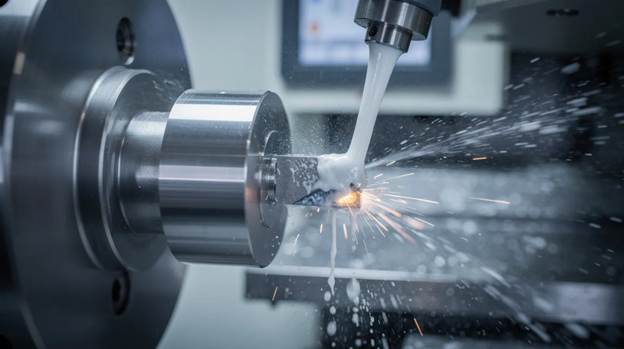
CNC machining uses computer numerical control to drive machine tools – mills, a lathe, grinders – through programmed instructions rather than manual handwheels. The production process follows a clear sequence: a CAD drawing is created, CAM software generates toolpaths, the operator sets up the cutting tool and fixtures, and the machine then runs automatically to remove material with repeatable accuracy. CNC turning uses single-point cutting tools on rotating workpieces to produce shafts and bushes, while CNC milling cuts plates, housings, and brackets. Manchester’s sector adapts to Industry 4.0 through digital manufacturing and automation technologies, and CNC machining services include turning and milling operations as standard.
At Elmax, our CNC machines handle a wide range of materials – stainless steel, aluminum, tool steels, and engineering plastic – routinely holding tolerances suitable for food, medical, construction, and automotive components. The ability to program once and repeat indefinitely gives CNC a clear edge over handwheel-driven manual equipment for any job requiring repeatability and consistent surface finish.
What Is Manual Machining?
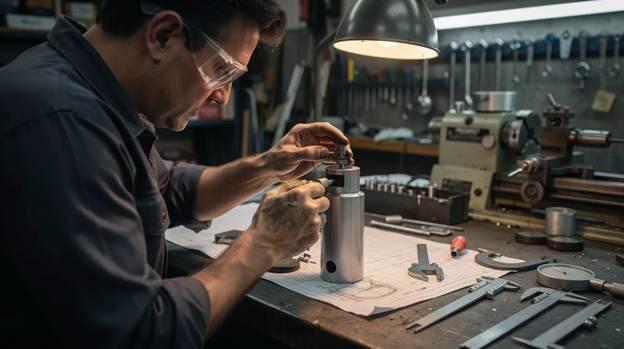
Manual machining is the traditional approach: a skilled machinist operates a centre lathe, turret mill, or grinder by hand, controlling every movement, feed, and depth of cut through levers and handwheels. Typical equipment in a manual workshop includes drilling machines, manual cylindrical grinders, and surface grinders – all operated without software or automated toolpaths.
Common use cases include one-off repairs, quick modifications to existing parts, small jigs, and low-volume work where CAD/CAM programming would not be economical. At Elmax Engineering, our team still relies on manual expertise for fine-tuning prototypes, setting up initial runs before handing work to CNC for batch production, and machining legacy parts that lack digital data. These craft skills – reading a workpiece by feel, adjusting feeds mid-cut – remain central to manchester precision engineering.
Key Differences: CNC vs Manual Machining
Choosing between CNC and manual machining comes down to accuracy, speed, complexity, setup time, and labour. Here is how they compare across the factors that matter most to engineering buyers.
Accuracy and repeatability: CNC machines hold consistent tight tolerances – CNC machining tolerances can range from ±0.005″ to 0.01″ – across entire batches. Manual machining depends more on operator skill and typically achieves tolerances in the ±0.1 mm range, with lower repeatability over longer runs.
Speed and throughput: CNC excels at high-volume production; once the program exists, parts cycle quickly with minimal intervention. Manual machining suits small quantities where setup is minimal but each operation takes longer.
Complexity: CNC can produce complex 3D geometries – internal pockets, compound angles, multiple faces in one set-up. Manual machines are limited to simpler shapes like external profiles and basic bores.
Setup and changeover: CNC has higher initial programming time but faster repeat runs. Manual machining is quicker to start on a single part but slower when repeated batches are needed.
Labour: CNC allows one operator to oversee multiple machines, improving efficiency and reducing per-part cost. Manual operation requires constant hands-on work, increasing labour cost and the risk of fatigue-related error.
For customers needing high quality components with strict deadlines – food processing equipment, medical housings, automotive shafts – we typically recommend CNC machining combined with grinding where tighter tolerances or better finish are required.
CNC Machining Services at Elmax Engineering Ltd
Elmax Engineering is a Manchester precision engineering partner offering complete CNC machining from prototype to production. Companies in Manchester typically offer 3 to 7-axis CNC machining services, and our capacity lets us produce parts in volumes from 1 to 100,000 with consistent quality. Precision engineering firms handle orders from prototypes to large-scale production, and we are no exception.
Our CNC turning capabilities cover shafts, bushes, threaded parts, and stepped components across diverse industries. We achieve tight concentricity and surface finish on diameters from small pins to larger rollers, at length ranges suitable for food, medical, construction, and automotive parts. CNC milling typically operates on a 3-axis system for cutting, and our milling capacity produces brackets, plates, housings, blocks, and precision fixtures – machining multiple faces in a single set-up for accuracy and reduced cycle time.
We combine turning and milling with secondary operations like keyway slotting, tapping, and grinding to deliver ready-to-assemble components. Our team works from STEP, DXF, or PDF data supplied by clients, taking projects from drawing through to finished part.
Grinding and Finishing: When Accuracy Demands More
Precise grinding is often employed to ensure dimensionally exact surface finishes that go beyond what a cutting tool alone can achieve. After CNC or manual machining, grinding corrects minor distortions and delivers the tolerance and finish needed for bearing fits, seal diameters, and hygienic surfaces.
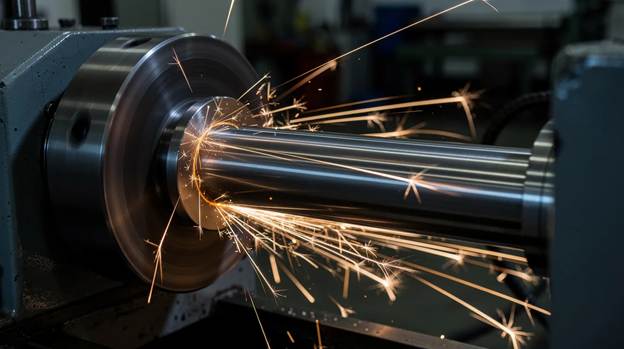
Our cylindrical grinding services uses a rotating grinding wheel to finish shafts, pins, rods, and other round components. External cylindrical grinding focuses on the outer surfaces of workpieces, while internal cylindrical grinding targets the inner surfaces. Centerless grinding, which does not require centers to support the workpiece, handles bars and smaller parts efficiently. A cylindrical grinder can grind materials including metals, ceramics, and composites, and the process achieves tight tolerances and smooth finishes – often reaching Ra 0.4–0.8 µm. It is commonly used in the automotive industry for crankshafts and similar rotating components where the control wheel and grinding wheel work together to shape the part.
Our surface grinding service creates flat, parallel surfaces on plates, tooling faces, and precision spacers. The workpiece is held on a magnetic chuck while the grinding wheel removes material to precise depth, correcting warping after heat treatment. Our team selects appropriate grinding wheel types and coolants to suit the material and specific requirements of each job – whether that means a polished finish for medical equipment or a dimensionally exact mating face for an automotive assembly.
Materials: Wide Range of Metals and Engineering Plastics
Both CNC and manual machining at Elmax Engineering cover a wide range of materials. CNC machining can work with over 50 types of metal and plastic materials, and we regularly machine high-precision components from titanium and aluminum alongside other materials including copper, brass, tungsten, mild steel, carbide-tipped tooling blanks, and titanium alloys.
Our metals range includes stainless steels (303, 304, 316) suitable for food and medical components, carbon and alloy steels for construction and the automotive industry, aluminum grades for lightweight housings, and tool steels for wear-resistant parts and jigs. We also machine selected engineering plastics such as acetal (POM) and nylon, used where weight reduction or corrosion resistance matters. Material choice influences whether CNC or manual machining is most efficient – aluminum is fast to cut; steel and titanium demand different tools and speeds – and we advise customers during quotation so they achieve the best balance of cost and quality.
Quality Assurance and Inspection
Whether a part is produced by CNC or manual machining, Elmax Engineering follows the same quality-focused process. CNC machining often requires adherence to quality management systems including ISO certification, and we maintain rigorous standards across every operation. The sector is involved in advanced assemblies and quality assurance using CMM technology, and cooperation between manufacturers and universities supports innovation in advanced manufacturing across the region.
Our standard inspection practices include calibrated equipment – micrometers, verniers, bore gauges, height gauges – used on the shop floor for first-off inspection and in-process checks during production runs. We work to customer drawings and specifications, recording key dimensions for traceability. High-quality components are essential for safety-critical industries, and consistent accuracy across machining and grinding operations is non-negotiable in sectors like food processing machinery, medical handling equipment, and automotive assemblies.
Applications and Typical Components
Elmax handles B2B projects for manufacturers across Manchester and the UK. Precision engineering companies in Manchester serve sectors including aerospace and automotive, along with food, medical, and construction – and we manufacture components for all of them across multiple industries.
Typical CNC-machined and ground components include shafts and rollers for food processing lines, housings and precision blocks for medical and laboratory equipment, pins, spacers, and threaded components for construction hardware, and automotive parts such as bushes, collars, fixtures, and jigs. For aerospace applications, we machine parts from specialist alloys where shape and tolerance are critical. We choose CNC for repeatable batches and complex geometry, and manual machining for quick-turn modifications, small repair items, or legacy parts without CAD data – ensuring every client gets the most cost-effective route.
Choosing Between CNC and Manual Machining for Your Project
The best process depends on quantity, tolerance, complexity, lead time, and budget. For high quality components requiring tight tolerances, repeat orders, or complex shapes, CNC machining – possibly combined with grinding – is almost always the most cost-effective choice. Where only a single replacement part is needed, or where the design is likely to change during development, manual machining offers greater flexibility at lower upfront cost.
We encourage readers to send drawings or sample parts to Elmax Engineering for a recommendation. Our team can often combine methods – CNC turning followed by cylindrical grinding for a bearing journal, or manual modifications to a CNC-milled prototype – to deliver the best result for your specific requirements and budget.
Why Work with Elmax Engineering Ltd in Manchester?
Since 2003, Elmax Engineering has provided precision engineering services in Stockport, Manchester, with a focus on reliability, accuracy, and responsive lead times. Engineering services in Manchester emphasize exact specifications and reliable delivery, and our track record across diverse industries reflects that commitment. Manchester’s precision engineering sector supports high-tech manufacturing, and we are proud to be part of it.
We offer flexible capacity for one-off prototypes, small batches, and larger production runs – with CNC machining, manual machining, cylindrical grinding, surface grinding, and keyway slotting all equipped under one roof. Our expertise spans food, medical, construction, automotive, and aerospace sectors. Our customer-focused approach means collaborative problem solving, manufacturability advice from the outset, and support from quotation through to delivery.
Contact Elmax Engineering to discuss your next CNC or manual machining project. We are based at Unit 7, Kenwood Road, North Reddish, Stockport SK5 6PH – serving clients across Manchester and the wider UK.


Leave a comment