CNC machining is a computer-controlled manufacturing process used to cut, shape and finish metals and plastics into high quality components with exceptional accuracy. From stainless steel shafts to aluminium housings, this technology underpins modern production across food, medical, construction and automotive sectors.
Elmax Engineering Ltd is a precision engineering company based in Stockport, Greater Manchester. Founded in 2003, the business specialises in CNC machining – delivering everything from one-off prototypes to high volume batch production. Using programmed cnc machine tools such as cnc milling machines and cnc lathes, the team provides fast turnaround and cost effective parts built to exact customer specifications.
Manchester is home to one of the UK’s largest advanced manufacturing clusters, and CNC machining and CAD/CAM development are key services offered in the city’s precision engineering sector. Manchester’s precision engineering sector drives advanced manufacturing across the UK, supplying critical components to industries that demand reliability and tight tolerances.
Here is what this article covers:
- How CNC machining works, step by step
- Core processes: cnc milling, cnc turning, drilling and tapping
- Cylindrical grinding and keyway slotting
- Materials, components and industries served
- Benefits for UK manufacturers
- How to choose the right machining partner in Manchester
How CNC Machining Works
CNC stands for computer numerical control. At its core, CNC machining is a subtractive manufacturing process – a cnc machine removes material from a solid billet or bar using programmed cutting tools to produce a finished part in the desired shape. Unlike additive methods such as 3D printing, this production process starts with more material than the final product requires and cuts away the excess with high precision.
The basic workflow follows these stages:
- Design – A CAD model is created, defining geometry, dimensions and tolerances.
- Programming – Computer aided manufacturing (CAM) software converts the CAD model into G-code, forming the cnc program that controls every movement of the machine.
- Setup – The workpiece is mounted in fixtures, cutting tools are loaded, coolant is set, and axes are aligned.
- Machining – The cnc machine runs the programmed machining processes – milling, turning, drilling or a combination – with minimal human intervention.
- Inspection and delivery – Finished parts are measured against specifications using micrometers, gauges and other instruments, then dispatched.
CNC machining uses computer-controlled machines for precision manufacturing, and modern equipment at Elmax Engineering achieves tight tolerances of ±0.01 mm on many steel and aluminium parts. Multiple axes – including X, Y, z axes and rotary axes – allow the production of complex geometries. Different processes such as cnc milling, cnc turning and cylindrical grinding can be combined to complete a single component, whether that is a stainless steel shaft for a food processing line or an aluminium housing for medical devices.
CNC machining can produce complex 3D shapes from various materials, and it allows for high production output with consistent quality across every batch.
Main CNC Machining Processes
CNC machining is an umbrella term covering cnc milling, cnc turning and related machining processes like drilling, tapping and boring. Each process suits different part geometries, and experienced manufacturers combine them to produce complex components efficiently.
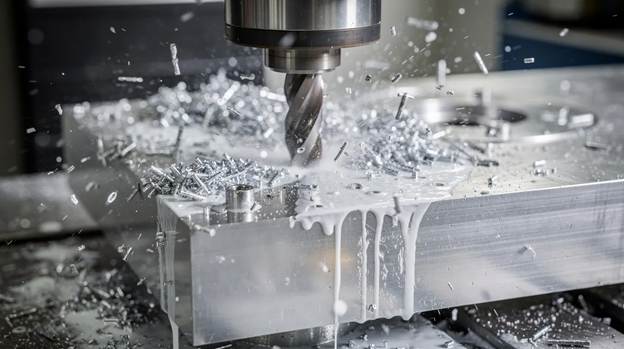
A cnc milling machine uses a rotating cutting tool that moves across a stationary workpiece along different axes. CNC milling machines can operate on 3, 4, or 5 axes, enabling everything from simple flat surfaces to intricate designs with undercuts and contoured profiles. CNC milling is widely used in automotive and aerospace industries for brackets, manifolds, valve blocks and structural plates.
In cnc turning, the workpiece rotates in a cnc lathe while a single-point cutting tool moves into the spinning material along X and Z axes. CNC turning creates cylindrical parts by rotating the workpiece, making it ideal for producing parts like shafts, bushings, pins and threaded connectors. CNC turning can produce complex geometries like conical shapes, grooves and chamfers in a single operation.
When choosing between these processes, the rule is straightforward: if the part is primarily cylindrical, cnc turning is faster and delivers better concentricity. If the part has flat surfaces, pockets, slots or irregular surfaces, cnc milling is the better option. Many components require both – a shaft might be turned on a lathe, then moved to a milling machine for flats or cross-drilled holes.
Drilling, tapping and boring are frequently executed on the same cnc machines during the same setup. Completing multiple features without removing the workpiece improves accuracy, reduces error accumulation and shortens lead times.
CNC Milling in Detail
CNC milling service removes material using multi-point rotary cutters on a cnc milling machine. The cutting tool spins at high speed while the workpiece remains fixed to the table, and the machine moves along different axes to carve flat faces, pockets, slots and complex 3D surfaces. CNC milling can produce complex 3D shapes with high precision, which is why the process is central to manchester precision engineering.
The CNC milling process begins with a CAD model converted to G-code, which directs every movement of the machine tools. Concrete examples of milled parts at Elmax Engineering include aluminium valve blocks for food processing plants, stainless steel plates for medical fixtures, and mild steel construction brackets.
Using 3-axis and 4-axis milling, machinists can reach multiple faces of a component without refixturing. This reduces handling, improves dimensional accuracy and enables cost effective production of intricate parts. Proper selection of cutting tools and machining parameters – feed rates, spindle speeds, depth of cut – allows fast turnaround while maintaining surface finish and tight tolerances.
Key capabilities include:
- Machining a wide range of materials including aluminium, stainless steel, brass and engineering plastic
- Prototypes through to large batch runs
- Tolerances down to ±0.01 mm on functional features
CNC Turning in Detail
CNC turning serviiices uses a cnc lathe where the bar or billet rotates while a cutting tool moves along X and Z axes to create cylindrical and conical forms. The process uses a cutting tool that moves into the rotating workpiece, shearing away material with each pass. CNC turning machines are also known as CNC lathes, and modern turning centres feature multiple tool stations for completing several features without stopping.
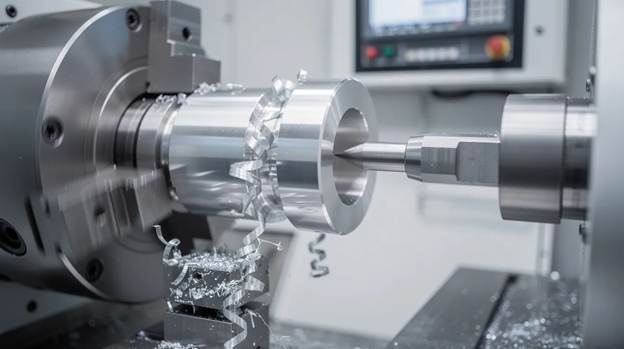
Common turned parts for Elmax’s customers include stainless steel drive shafts for conveyors, stepped spindles, threaded connectors and bushes for automotive fixtures. CNC turning is compatible with metals, plastics, and wood materials, though the majority of work in manchester precision engineering involves steel and aluminium alloys.
Advantages of cnc turning for round parts:
- Excellent concentricity and smooth finishes straight off the machine
- Efficient production processes for grooves, threads and chamfers in one setup
- Well suited to high volume production of turned parts
- Linear motion of the tool along programmed axes ensures repeatability
CNC turning can be combined with milling operations – for example, adding flats or keyways on a turned shaft. Multi-operation setups keep projects cost effective by reducing handling and the risk of misalignment between operations.
Additional Precision Machining Services (Grinding & Keyway Slotting)
Beyond core cnc machining, Elmax Engineering offers cylindrical grinding and keyway slotting to finish components to exact specifications. These additional services mean the entire production process stays in-house, avoiding the delays and coordination costs of subcontracting.
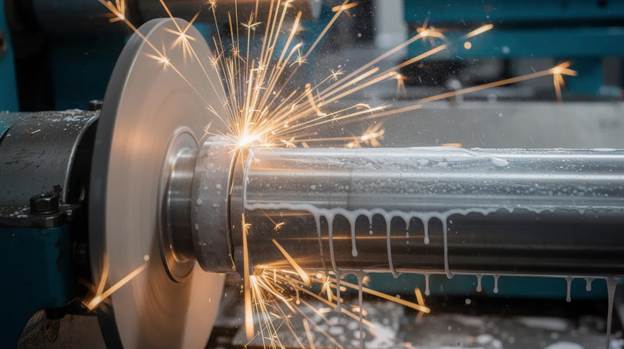
Cylindrical grinding achieves tight tolerances and smooth finishes by rotating the workpiece against a grinding wheel. The process removes minimal material – often just hundredths of a millimetre – to bring diameters, roundness and surface finish within demanding limits. External cylindrical grinding focuses on outer surfaces of workpieces such as bearing journals and precision shafts. Internal cylindrical grinding targets the inner surfaces of workpieces, while centerless cylindrical grinding holds workpieces without centers for high throughput on smaller parts. It is commonly used for engine crankshaft and camshaft grinding, and cylindrical grinding can process metals, ceramics, and composites. Practical examples include grinding hardened steel shafts for construction equipment or medical device components where a precise finish and hygiene-grade surface are critical.
Keyway slotting machines internal keyways in hubs or gears, ensuring accurate torque transmission. This is essential for food processing drives, automotive jigs and any assembly where rotational alignment matters. Methods include reciprocating slotters, broaching and keyseat milling, with the choice depending on bore type and volume.
Why these services complement cnc machining:
- Improved accuracy on critical diameters and bores
- Extended component life through superior surface finish
- Complete in-house machining service from raw material to finished part
Materials, Components and Industries Served
CNC machining is compatible with a wide range of materials. Elmax Engineering primarily works with stainless steel, mild steel, aluminium, brass, titanium alloys and selected engineering plastics. Material choice directly affects machinability, cost and the achievable surface finish – aluminium cuts faster and more predictably, while stainless steel demands sharper tooling and careful heat management.
Precision engineering companies typically manufacture components for the food and medical industries, and Elmax is no exception. Typical components include:
- Stainless steel fittings and valves for food production lines, meeting stringent quality standards for hygiene
- Aluminium housings and enclosures for medical equipment
- Steel fixtures, jigs and brackets for construction applications
- Milled and turned parts for automotive test rigs and production tooling
- Various types of connectors, spindles and bushings across different industries
The business handles both prototypes – one-off development parts for proof-of-concept testing – and high volume batch runs, maintaining consistent quality across all quantities. Local firms serve critical industries such as aerospace, automotive, and medical engineering, and CNC machining is widely used in automotive and aerospace industries where achieving tight tolerances on complex parts is non-negotiable.
Manchester and the wider North West manufacturing base benefit from local supply of high quality components. Shorter lead times are a direct benefit of choosing local manchester precision engineering partners, reducing risk for time-sensitive production schedules. The medical industry, food processing and construction sectors all rely on this regional capability.
Benefits of CNC Machining for UK Manufacturers
The core benefits of cnc machining come down to precision, repeatability, flexibility and efficiency across both low and high volume work.
Precision and quality. Modern cnc machines hold tight tolerances routinely – often ±0.01–0.05 mm on functional features – producing high precision components and complex geometries that fit first time into assemblies. High-quality standards are prevalent in UK-based engineering firms with certifications such as AS9100 and ISO 9001, and achieving tight tolerances consistently across a batch is what separates a reliable supplier from an unreliable one.
Productivity. Automated cnc machines run reliably with efficient production processes, enabling reduced lead times and potential multi-shift running for urgent or repeat orders. CNC machining delivers high accuracy and exceptional accuracy on every cycle, whether producing one component or one thousand.
Cost effective production. Compared with casting or injection moulding, cnc machining requires minimal tooling investment – critical for prototyping and short runs. Economies of scale kick in for recurring orders, and manufacturers in Manchester often benefit from lower operating costs than those in London.
Local advantages. Manchester provides good access to UK motorway networks and international air freight, making dispatch straightforward. Local partners in precision engineering help scale operations without compromising on quality standards, and close collaboration with a precision engineering partner like Elmax improves design-for-manufacture outcomes. A nearby workshop means site visits, technical discussions and urgent deliveries happen without friction.
CNC Machine Tools and Technology at Elmax Engineering
The capability of any cnc machining operation depends on the underlying cnc machines, machine tools and supporting equipment. Companies in Manchester utilize state-of-the-art software and multi-axis machinery to meet the specific requirements of demanding sectors.
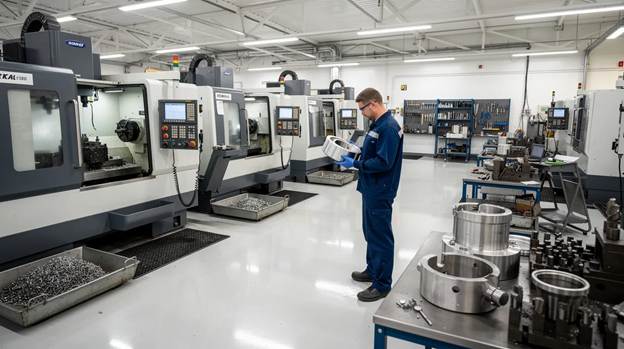
Elmax Engineering operates a mix of milling machines and cnc lathes featuring multiple tool stations, digital control and flexible fixturing. These machines handle various materials and part sizes, from small precision bushings to larger fabricated assemblies. Complementary equipment includes cylindrical grinders, dedicated keyway slotting machines, and inspection instruments such as micrometers and gauges to verify critical dimensions on every finished part.
Modern CAM software optimises toolpaths, reduces cycle times and protects spindles and cutting tools from unnecessary wear. This contributes to reliable, repeatable machining processes and consistent quality on the final product. The engineering sector in Manchester benefits from collaboration with universities and research centres, and STEM graduates from local universities contribute to the skilled engineering workforce that operates this equipment daily.
Typical CNC Machining Workflow with Elmax Engineering
Here is how a typical project flows from enquiry to delivery when working with Elmax Engineering in Manchester.
- Enquiry – You send a drawing, 3D model or sketch with your specific requirements.
- Engineering review and quotation – The team reviews geometry, material, tolerances and quantities, then provides a clear quote.
- Material selection – Appropriate stock is sourced, whether stainless steel, aluminium, brass or another material suited to your application.
- CNC programming – CAM software generates optimised toolpaths and the cnc program for each operation.
- Machining – Parts are milled, turned, ground or slotted as required. Complex components may pass through several machine tools.
- Inspection – Critical dimensions are checked against the drawing. Every component must meet specification before it leaves.
- Packing and dispatch – Parts are carefully packed and dispatched, with reliable delivery to your site.
Communication and collaboration with your design engineers throughout the process helps refine tolerances and features so that components are both functional and cost effective. Whether you need an urgent one-off prototype or scheduled high volume repeat batches, the workflow adapts.
Manchester is known for its unmatched industry expertise in aerospace and nuclear sectors. Nuclear R&D requires specialized capabilities in machining and fabrication, and the region’s manufacturing base supports these demands alongside the food, medical, construction and automotive work that forms Elmax’s core output. Larger firms provide complex projects requiring high-tolerance engineering and specialized assembly, making the local supply chain robust and well connected.
Choosing a CNC Machining Partner in Manchester
Selecting the right precision engineering partner plays a crucial role for manufacturers in food, medical, construction and automotive sectors. The wrong choice costs time, money and – in regulated industries – can compromise safety.
Key factors to assess when choosing a machining service provider:
- Experience – Elmax Engineering has operated since 2003, building deep knowledge across various industries
- Capability – Look for both cnc milling and cnc turning under one roof, plus additional services like cylindrical grinding and keyway slotting
- Quality control – Ask about measurement methods, inspection frequency and whether the supplier works to recognised standards
- Flexibility – Can they handle prototypes, small batches and high volume runs with equal reliability?
- Turnaround – Confirm realistic lead times, especially for urgent work or non-standard tooling
A local Stockport or Manchester supplier offers clear advantages: site visits are straightforward, technical discussions happen face-to-face, and urgent deliveries arrive the same day. This matters when you are iterating on a prototype or resolving a production issue under pressure.
Working with an established precision engineering company such as Elmax Engineering reduces risk, supports smoother production and helps maintain high standards in your finished assemblies. The combination of in-house services, experienced machinists, and a location at the heart of the UK’s manufacturing corridor makes a strong case for keeping your machining service local.
If you have a project that demands high precision components, consistent quality and reliable delivery, get in touch with Elmax Engineering to discuss your requirements and request a quotation.


Leave a comment