CNC machining sits at the heart of modern manufacturing. From aerospace brackets to surgical instruments, the ability to remove material with micron-level accuracy makes cnc turning, cnc milling, and cylindrical grinding fundamental to how things get built. Manchester firms commonly provide cnc machining for various sectors including aerospace and medical devices, and the precision engineering sector in Manchester specializes in large-scale cnc machining operations that keep critical industries running.
Greater Manchester is experiencing a revolution in precision engineering driven by digital smart machining and 3D printing. Companies like Elmax Engineering Ltd have spent decades delivering high precision components through cnc machining services, cylindrical grinding, and keyway slotting-serving everything from one-off prototypes to high volume production runs.
Here are 15 industries that depend on precision machined components, why they need them, and what to look for when choosing a machining partner.
How We Identified These Key Industries
We selected these industries based on five core criteria:
- Tolerance demands – precision components require tight tolerances for functionality, and cnc machining can achieve tolerances as low as ±0.01 mm
- Component complexity – sectors needing multi-axis milling and complex geometries
- Material requirements – industries working with metals, alloys, plastics, and exotic materials, since cnc machining can produce parts from various materials
- Production range – sectors requiring prototyping through to mass production
- Quality standards – markets demanding iso 9001, traceability, and reliable on time delivery
Advanced CNC technology enhances the production of precision components across all of these sectors. Precision engineering in Manchester focuses on aerospace, automotive, and nuclear sectors, but the range extends far beyond those three.
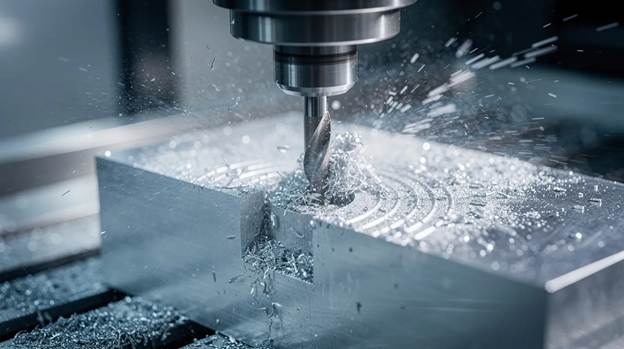
15 Industries That Rely on CNC Machining
1. Aerospace Industry
Aerospace is where precision engineering meets zero margin for error. The UK aerospace sector contributes roughly £34 billion in turnover, with output rising 12.1% year-on-year in early 2026.
Why It Relies on CNC: Extreme tolerances (often ±0.005–0.01 mm) and materials like titanium and Inconel demand engineering expertise that only advanced machining can deliver. High-precision machining enables aerospace suppliers in Manchester to produce complex engine components with the reliability these applications demand.
Best CNC Applications For: Turbine blades, structural brackets, housings, and landing gear components.
Key Requirements: 5-axis machining is widely used to produce complex high-tolerance parts in Manchester, and 5 axis cnc machining allows for complex geometries that would be impossible with conventional setups. Precision technology is utilized to build light, tough parts for aerospace to enhance safety and fuel efficiency. High precision components are critical in aerospace and medical industries alike. CNC milling services are used extensively in aerospace and automotive industries.
Common Challenges: Stringent quality standards (AS9100D, NADCAP), full material traceability, and complex projects requiring multiple operations in a single setup.
2. Automotive Industry
Automotive manufacturing demands efficient production processes that balance quality with cost. While UK automotive output has seen fluctuations-falling 3.3% YoY in Q1 2026-the sector remains a major consumer of machined components.
Why It Relies on CNC: High volume production with consistent quality across thousands of parts. Hemlock Engineering produces thousands of components annually, and cnc milling can produce thousands of components annually when paired with automated bar feeding and efficient process planning.
Best CNC Applications For: Engine blocks, transmission shafts, brake system components, and custom parts for specialist vehicles.
Key Requirements: Cost effective batch production, fast turnaround, and the ability to scale production capacity quickly. Climb milling techniques help optimize surface finish and tool life in high-speed automotive machining.
Common Challenges: Price pressure from global competition (including manufacturers in china), volume fluctuations, and tight deadlines across model year cycles.
3. Medical Device Manufacturing
Medical device manufacturing operates under some of the tightest regulatory frameworks in any industry. Critical features on Class III implants often require tolerances of ±0.013 mm, with full documentation from raw material to finished part.
Why It Relies on CNC: Biocompatibility demands and surgical precision standards mean every component must be flawless. Nanoscale engineering in Manchester improves tiny surgical tools and implants in medical technology, pushing what’s possible in development of life-saving devices.
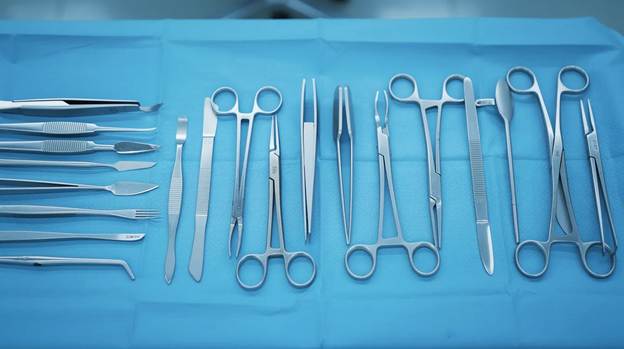
Best CNC Applications For: Surgical instruments, orthopaedic implants, diagnostic equipment housings, and laboratory assembly fixtures.
Key Requirements: Medical-grade materials (precision components can be produced from various materials including titanium), sterile processing environments, and ISO 13485 compliance. ISO 9001:2015 certification ensures quality in precision components used in these critical applications.
Common Challenges: Regulatory validation cycles, material restrictions on biocompatible alloys, and the need for complete service from prototyping through production.
4. Food Processing Equipment
Food processing equipment must meet strict hygiene and safety standards defined by CEN ‘C’ specifications, including BS EN 1672-2 for hygienic design.
Why It Relies on CNC: Food-safe materials and sanitary design require smooth, crevice-free surfaces that only precision machining can deliver. Digital inspection technologies are reducing manufacturing variation in precision engineering, which directly supports consistent hygiene compliance.
Best CNC Applications For: Processing machinery, packaging equipment, conveyor rollers, and mixing components.
Key Requirements: Stainless steel expertise (304, 316 grades), surface finishes with low Ra values, corrosion resistance, and easy cleaning. Sometimes powder coating is applied for additional protection on non-contact surfaces.
Common Challenges: Meeting hygiene standards while maintaining cost efficiency across medium-volume batch runs.
5. Construction and Building
Construction components don’t always require aerospace-level accuracy, but they do demand reliability, custom sizing, and weather resistance.
Why It Relies on CNC: Custom fittings and structural connectors need precise dimensions to ensure safe assembly on site. Local industries in Manchester are fostering supply chain resilience by sourcing components locally rather than importing.
Best CNC Applications For: Architectural hardware, structural connectors, custom brackets, and engineered fastening systems.
Key Requirements: Weather-resistant materials, load-bearing accuracy, and flexible production scheduling to accommodate specification changes.
Common Challenges: Project timeline pressures, last-minute design changes, and the need for a reliable machining partner who can work to tight deadlines.
6. Oil and Gas Industry
Oil and gas components operate in extreme environments-high pressure, corrosive fluids, and remote locations where failure isn’t an option.
Why It Relies on CNC: Extreme environment durability and pressure resistance demand high quality components with certified materials. CNC turning can produce components from 1mm to 250mm diameter, covering everything from small valve stems to large pump shafts. CNC turning utilizes fixed and sliding head lathes to handle this range efficiently.
Best CNC Applications For: Valves, pump housings, drilling equipment parts, and pipeline fittings.
Key Requirements: Corrosion resistance, high-pressure tolerances, material certification (MTRs), and plating for additional environmental protection.
Common Challenges: Harsh operating conditions, exotic material selection, and long lead times on certified alloys.
7. Marine and Shipbuilding
Saltwater is unforgiving. Marine engineering demands materials and finishes that can withstand constant corrosion while maintaining structural integrity.
Why It Relies on CNC: Large marine components need precise machining in corrosion-resistant alloys like bronze, stainless steel, and aluminium. CNC milling can process parts up to 2000 x 750 x 600 mm, making it suitable for larger deck fittings and structural components.
Best CNC Applications For: Propeller components, shaft couplings, deck hardware, and engine parts.
Key Requirements: Marine-grade materials, corrosion resistance, and large component machining capability with grinding for sealing surfaces.
Common Challenges: Saltwater corrosion management and the sheer size of some components, which may test a shop’s production capacity.
8. Defence and Military
Defence applications share many requirements with aerospace but add layers of security, ruggedness, and certification that make them uniquely demanding. UK defence spending is projected to reach approximately 2.6% of GDP by 2027.
Why It Relies on CNC: Mission-critical reliability means every component must perform under the worst conditions. Advanced metrology supports nuclear engineering through accurate manufacturing of critical components used in defence and energy applications.
Best CNC Applications For: Weapon system components, armoured vehicle parts, communication equipment housings, and optical mounts.
Key Requirements: Security clearance, material traceability, rigorous testing, and compliance with military specifications.
Common Challenges: Classified projects limiting supplier options, specialized material requirements, and long qualification cycles.
9. Electronics and Telecommunications
Miniaturisation drives the electronics sector. Components are getting smaller, tolerances tighter, and surface finish expectations higher.
Why It Relies on CNC: Precision enclosures, heat sinks, and connector housings require accuracy measured in microns. CNC turning is used for high precision components like contact pins and connector bodies where dimensional consistency is everything.
Best CNC Applications For: Heat sinks in aluminium, RF enclosures, connector housings, and antenna mounts.
Key Requirements: Tight tolerances, surface finish quality, electrical conductivity properties, and the ability to work with almost any material from copper to engineering plastic.
Common Challenges: Component miniaturisation pushing equipment limits and managing electrical conductivity requirements across different metal alloys.
10. Energy and Power Generation
Power generation equipment-turbines, generators, transformers-demands components that perform efficiently under extreme thermal cycling.
Why It Relies on CNC: High efficiency and thermal management needs require precision balancing and exact dimensional accuracy. Advanced materials from local hubs enhance the durability of wind turbines and batteries in renewable energy applications.
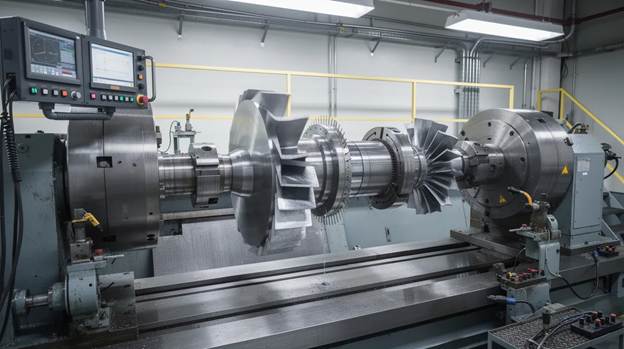
Best CNC Applications For: Turbine components, generator shafts, rotor assemblies, and transmission equipment.
Key Requirements: High-temperature resistance, precision balancing to sub-micron levels, and efficiency optimization through tight grinding tolerances (OD diameter ±1–10 μm).
Common Challenges: Thermal cycling fatigue and the constant push for higher efficiency in both conventional and renewable energy systems.
11. Pharmaceutical Manufacturing
Pharmaceutical equipment demands cleanliness, precision, and complete validation-similar to medical devices but focused on process machinery rather than implants.
Why It Relies on CNC: Sterile processing and precise dosing require machined components with verified dimensions and contamination-free surfaces. Manufacturers in Manchester are increasingly focused on sustainable production practices in precision engineering, and local industries in Manchester are working towards recycling metal and saving energy for eco-friendliness.
Best CNC Applications For: Processing vessels, packaging machinery, laboratory instruments, and dosing equipment.
Key Requirements: FDA-compliant materials, sterile surface finishes, precise measurements, and full batch traceability.
Common Challenges: Validation requirements that can extend timelines and the constant need to prevent contamination during the production process.
12. Agricultural Machinery
Agricultural equipment faces unique demands: seasonal production cycles, harsh field conditions, and the need for reliability when downtime means lost harvests.
Why It Relies on CNC: Seasonal reliability and field-condition durability require rugged, precisely machined wear parts. CNC turning can handle both prototypes and large-scale production, making it ideal for seasonal ramp-ups.
Best CNC Applications For: Harvesting blade holders, irrigation pump components, tractor hydraulic fittings, and plough attachments.
Key Requirements: Weather resistance, material durability, and support for seasonal production scheduling that keeps components in house and ready when needed.
Common Challenges: Demand fluctuations between seasons and the need for parts that survive years of outdoor exposure.
13. Robotics and Automation
Robotics demands the kind of precision that translates directly into positional accuracy and repeatability at the end effector.
Why It Relies on CNC: Precise motion control requires components machined to micron-level accuracy. 5 axis CNC milling machines can handle complex multi-axis operations needed for robot joint housings and actuator bodies. CNC milling is essential for producing high-precision components in this rapidly growing sector. Local precision engineering firms are adopting AI-enabled CNC machining and automation to meet rising demand.
Best CNC Applications For: Robot joints, actuator housings, precision gears, and end-effector mounts.
Key Requirements: Tight tolerances for smooth operation, lightweight materials, and combined turning and milling operations in single setups.
Common Challenges: Achieving the accuracy required for reliable motion across thousands of cycles.
14. Packaging Industry
Packaging machinery runs at extraordinary speeds. Every component must maintain dimensional accuracy under constant high-speed operation and vibration.
Why It Relies on CNC: Consistent product handling at speed requires wear-resistant, precisely machined parts. Precision engineering in Manchester supports blue-chip OEMs with micron-level tolerances that keep packaging lines running without interruption.
Best CNC Applications For: Filling nozzles, sealing jaws, conveyor rollers, and cam mechanisms.
Key Requirements: Wear resistance, efficiency in high-speed operation, and easy maintenance access.
Common Challenges: Balancing speed optimization with the longevity of machined components under constant use.
15. Textile Manufacturing
Textile machinery requires smooth, precise components that handle delicate fabrics without damage while maintaining high production speeds.
Why It Relies on CNC: Precise fabric handling and consistent production quality depend on rollers, guides, and cutters machined to exact specifications. CNC turning is part of a complete engineering service that covers the full range of textile machinery components.
Best CNC Applications For: Weaving loom parts, rotary cutters, finishing rollers, and tensioning equipment.
Key Requirements: Smooth surface finishes, fabric-friendly contact surfaces, and precision timing mechanisms.
Common Challenges: Fabric sensitivity requiring burr-free edges and the need for reliable, efficient long-run production.
Quick Comparison of Industry CNC Requirements
| Industry | Primary CNC Need | Key Differentiator |
| Aerospace | 5 axis milling, grinding | Exotic materials, extreme precision |
| Automotive | High-volume turning, milling | Cost efficiency, speed |
| Medical | Micro-machining, finishing | Biocompatibility, regulatory compliance |
| Food Processing | Stainless steel machining | Hygiene, corrosion resistance |
| Construction | Custom milling, turning | Weather resistance, custom sizing |
| Oil & Gas | Heavy-duty turning | Pressure resistance, certification |
| Marine | Large-format milling | Saltwater corrosion resistance |
| Defence | Multi-process machining | Security, traceability |
| Electronics | Precision micro-milling | Miniaturisation, conductivity |
| Energy | Grinding, balancing | Thermal resistance, efficiency |
| Pharmaceutical | Sterile machining | Contamination prevention |
| Agricultural | Rugged turning | Seasonal durability |
| Robotics | 5 axis milling | Motion accuracy |
| Packaging | High-speed turning | Wear resistance |
| Textile | Precision finishing | Fabric-safe surfaces |
How to Choose the Right CNC Partner for Your Industry
Choose Based on Industry Experience
Sector-specific knowledge matters enormously. A shop that understands aerospace traceability requirements operates differently from one optimised for food-grade hygiene. Manchester precision engineering companies like Elmax Engineering develop industry expertise across multiple sectors over decades of operation, building the kind of institutional knowledge that translates into high quality results on your cnc machining project.
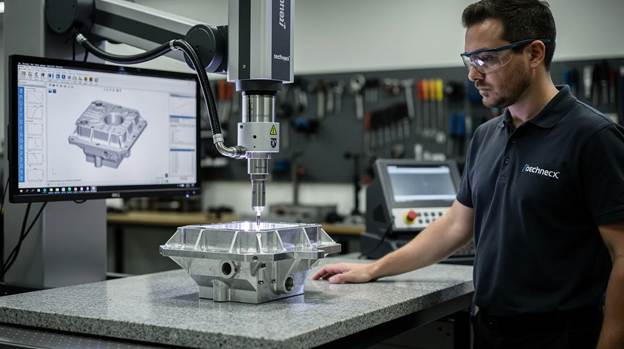
Quality inspection in Manchester’s precision engineering sector emphasizes CMM and laser measuring to verify that every component meets specification before it ships.
Choose Based on Manufacturing Capabilities
Match your partner’s equipment to your needs. Consider whether they offer prototyping through to large-scale production. Companies across the UK like Xometry offer prototyping to high-volume production services, and Xometry has over 5,000 manufacturers for cnc machining. Get It Made delivers projects 1.5 days ahead of schedule. MNB Precision handles both prototype and high-volume production. Parallel Precision offers prototype and small batch production. The best partner provides flexible production capacity that scales with your requirements.
Choose Based on Quality Systems
Industry-specific certifications are non-negotiable. Hemlock Engineering is ISO 9001:2015 certified. Xometry follows iso 9001 standards for quality assurance and provides inspection reports and compliance certificates. M-CNC Precision Engineering meets ISO 9001 and ISO 14001 standards. DJJ Precision Engineering is ISO 9001:2015 certified by TUV Rheinland. These quality standards form the baseline-your partner should also demonstrate expert advice on material selection and process optimization.
Which CNC Services Are Best for Your Industry?
- Choose CNC turning services for cylindrical components and high-volume production-shafts, pins, bushings, and fittings across industries from oil and gas to automotive
- Choose CNC milling service for complex geometries, custom prototypes, and complex components requiring multi-axis operations
- Choose cylindrical grinding for precision surface finishes and tight tolerances where turning alone cannot achieve the required accuracy or surface quality
- Choose keyway slotting for power transmission assemblies-any application involving shafts, gears, and couplings that need secure mechanical connections
Many projects benefit from additional services that combine multiple processes. The most cost effective approach often involves a partner who can produce your part through turning, milling, and grinding in house without subcontracting between shops.
Final Thoughts
CNC machining serves an extraordinary range of industries, each with distinct material requirements, tolerance demands, and regulatory frameworks. From the extreme precision of aerospace to the rugged reliability demanded by agricultural equipment, the common thread is the need for a machining partner with the right equipment, experience, and quality systems.
Manchester precision engineering has served these industries for decades, and companies like Elmax Engineering continue to deliver the accuracy, reliability, and efficient service that clients across all 15 sectors depend on. Whether your next project calls for a single prototype or a production run of thousands, choosing the right partner starts with understanding your industry’s specific demands. If you have an upcoming cnc machining project that requires precision, research your options carefully-and talk to a team that understands both the process and your industry.


Leave a comment