Choosing between CNC turning services and Swiss turning comes down to part geometry, tolerances, and volume. This guide breaks down when each process makes sense and how Elmax Engineering Ltd in Stockport helps customers across multiple industries get the right result.
Quick Answer: When to Choose CNC Turning vs Swiss Turning
Key considerations for any cnc machining service include part complexity and production volume. Here is the short version:
- CNC turning suits shafts, housings, and flanges from approximately 5–250 mm diameter. It handles rigid parts well and offers flexibility for prototypes through to medium batches.
- Swiss turning excels on slender, high-volume parts typically 1–32 mm diameter, where deflection and chatter would compromise accuracy on a conventional lathe.
Swiss turning is the go-to for long, small-diameter components such as medical pins, dental implants, or automotive connector pins. Conventional cnc turning suits larger, stiffer parts and delivers high quality components without the setup overhead of a sliding-head machine.
Elmax Engineering focuses on high-precision CNC turning and cylindrical grinding for tight tolerances. When Swiss turning is more cost-effective, the team coordinates production through trusted partners.
Key advantages at a glance:
- CNC turning: tolerances ±0.01 mm, surface finish Ra 0.8–3.2 µm, diameters up to 250 mm
- Swiss turning: tolerances ±0.005–0.013 mm, surface finish Ra 0.2–0.4 µm, cycle times often under 5 seconds per part
- CNC machining can produce components from 1mm to 250mm diameter, covering nearly every turned-part requirement
What Is CNC Turning?
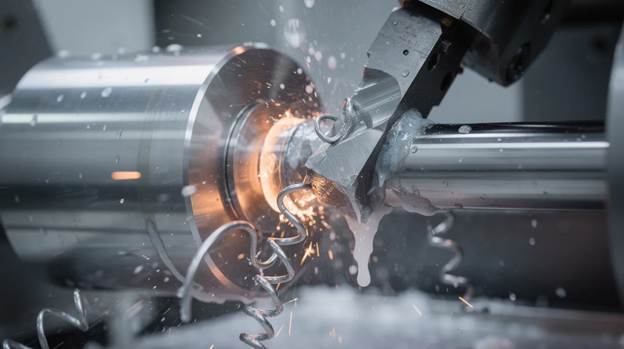
CNC turning is a production process where the workpiece rotates in a chuck or collet on a fixed-headstock lathe while cutting tools move along the X and Z axes. The tool removes material in programmed passes, shaping cylindrical, conical, and faced features with repeatable accuracy.
The process involves bar or billet loading, clamping in a 2- or 3-jaw chuck, roughing and finishing passes, and part-off. Automated tool changing in CNC machining drastically reduces production lead times, and CNC machines eliminate human error during production ensuring part consistency. CNC machining allows fast iterations and prototypes through quick CAD updates, so design changes rarely stall a project.
Typical parts Elmax produces include stainless steel shafts for food processing, mild steel construction pins, aluminium housings, and automotive bush carriers. CNC machines can work with a wide range of materials including metals and plastics-EN8, EN24, 303/304/316 stainless, 6082 and 7075 aluminium, brass, and other materials such as PEEK, nylon, and acetal. The machines can handle almost any material a designer specifies.
CNC turning can produce components from 1mm to 250mm diameter, with turning length up to 500 mm or more depending on machine model. CNC machining is used in industries like food, medical, and automotive, and can handle orders from prototypes to large-scale production.
What Is Swiss Turning (Sliding Head Turning)?
Swiss turning-also called sliding-head machining-feeds bar stock through a rotating guide bushing so the cut happens millimetres from the support point. This drastically reduces the unsupported length of the workpiece, which is essential for slender parts that would vibrate or bend in a conventional setup.
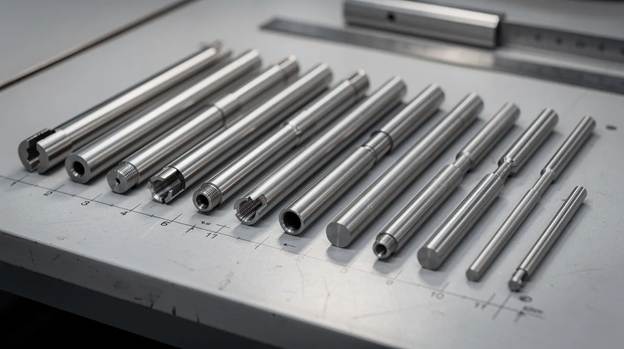
The process suits diameters from about 1–32 mm and length-to-diameter ratios well above 3:1. Gang tooling handles turning, drilling, and simple cnc milling features, while a sub-spindle picks off the part for back-end work-all in one cycle at speed. CNC machines can produce parts with high accuracy often to within 0.25 µm on critical features.
Concrete examples include bone screws (2–6.5 mm OD, titanium), miniature valves for food and beverage systems, and precision pins for automotive assemblies. A small part manufactured on a Swiss machine can cycle in roughly 3 seconds versus 8 seconds on a standard CNC lathe, delivering smooth surfaces and excellent concentricity across tens of thousands of identical components.
While Elmax Engineering does not position itself as a volume Swiss turning house, it advises customers when Swiss turning is technically preferable and coordinates production through vetted partners.
CNC Turning vs Swiss Turning: Key Differences
Below is a quick-scan comparison of the two approaches:
- Workpiece support: CNC turning relies on chucks, centres, and steady-rests. Swiss turning uses a guide bushing and sliding bar, giving superior stability on long, slender parts.
- Part geometry: CNC turning handles short-to-medium length parts, flanges, and complex components with large cross-sections. Swiss turning targets long shafts, small pins, and multi-featured miniature parts.
- Tolerance and surface finish: Both achieve precise tolerances, but Swiss turning holds consistent size over long runs of miniature parts. Elmax complements cnc turning with cylindrical grinding and surface grinding to refine critical fits. A magnetic chuck secures flat workpieces during surface grinding operations.
- Volume: CNC turning suits one-off prototypes, small batches, and medium production. Swiss turning becomes economical at medium-to-high volumes. CNC machines can run 24/7 allowing rapid production and increased efficiency in either case.
- Cost: For a handful of parts or larger diameters, conventional CNC turning is usually more cost-effective. CNC machining is cost-effective for large-volume production reducing labor costs significantly. Modern 5-axis CNC machines can create complex shapes difficult with manual machining, adding further value.
How Part Design and Tolerances Influence Your Choice
Engineers across food, medical, construction, and the automotive industry should decide based on geometry, tolerances, and material requirements-not machine labels alone.
When length-to-diameter ratios exceed 3:1 (especially above 5:1) and diameters drop below 10 mm, Swiss turning avoids bending and chatter. For hydraulic shafts or bearing journals, CNC turning plus a cylindrical grinder is often the better route. Cylindrical grinding achieves tight tolerances and smooth finishes using a rotating grinding wheel-or more precisely, a rotating abrasive wheel-that can grind materials like steel, aluminum, and titanium. In automotive applications, cylindrical grinding handles crankshaft and camshaft grinding, while internal cylindrical grinding is used for tubes and bores in medical devices. Centerless cylindrical grinding, which uses a control wheel to regulate workpiece rotation, allows for high precision in long rods. Cylindrical grinding can produce components up to 1900mm in length, and a grinding wheel paired with carbide or CBN abrasive delivers exceptional surface integrity.
Features like milled flats, keyways, and cross-holes can often be completed on a multi-axis CNC lathe. Difficult alloys or hardened steels may favour a shorter, more rigid CNC turning setup with specific requirements for coolant and tooling selection.
Share drawings with Elmax Engineering early so the team can advise whether standard CNC turning, Swiss turning, or a combination with grinding will meet tolerance, cost, and delivery targets.
Elmax Engineering’s CNC Turning, Grinding and Machining Capability
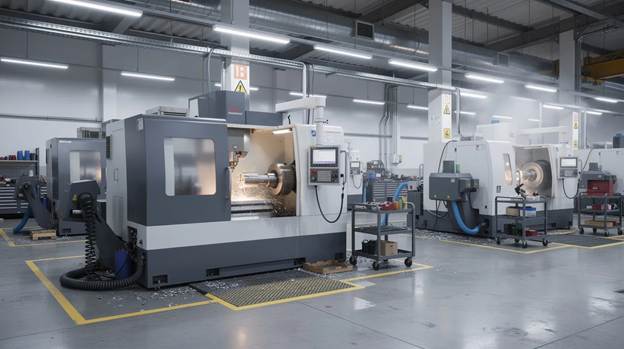
Elmax Engineering Ltd is a Stockport-based precision engineering company established in 2003, serving customers across Manchester and the wider uk. The business is equipped to manufacture components to exact specifications, from single prototypes to production runs of several thousand pieces.
- CNC turning: Fixed-head lathes covering approximately 5–250 mm diameter. CNC turning services manage the entire supply chain from raw material to finished part. Rapid prototyping services can often turn around simple parts in 1–3 days.
- CNC milling: 3, 4, and 5-axis machines for precision on prismatic features, bolt patterns, pockets, and custom parts. CNC milling uses these axes to produce thousands of components annually. Robotic loading increases CNC milling output five-fold in high-volume scenarios. Additionally, cnc milling integrates with turning to deliver complex components from one supplier.
- Cylindrical and surface grinding: In-house grinding on hardened or ground-finish parts using an abrasive wheel to achieve tight tolerances and superior surface finish on shafts and bearing seats.
- Keyway slotting: For shafts, hubs, and pulleys-completing components ready to assemble.
Quality certifications like ISO 9001 ensure consistent quality in cnc machining services. Quality assurance is critical in safety-critical industries and ensures compliance with stringent industry standards. CNC technology can handle strict dimensional tolerances using precise inspection equipment such as micrometers, bore gauges, and CMM where relevant. For context, firms like Hemlock Engineering operate 45 CNC machines and hold ISO 9001:2015 accreditation, while Denner Kelford Grinding holds AS9100 Rev D certification-demonstrating how the sector prioritises quality. Hemlock uses advanced inspection equipment for quality control across its operation. When selecting a cnc machining service, prioritize technical capabilities and quality certifications.
CNC machining allows for high precision and fast turnaround. Send 2D drawings or 3D models for an engineer-reviewed quotation-typically within one working day-with flexible delivery schedules to match your production capacity.
Key Advantages of Partnering with Elmax Engineering for Turning Projects
For uk manufacturers and OEMs seeking a dependable subcontractor, here are the key advantages of working with Elmax:
- Reliability: Consistent lead times and on-time delivery from a family-run business with over two decades of expertise in Manchester. The team delivers high quality results even under tight deadlines.
- Technical range: The ability to combine CNC turning, CNC milling, cylindrical grinding, and keyway slotting in a single workflow reduces handling and cumulative tolerances. Parts meet required specifications without bouncing between suppliers.
- Service flexibility: Support for urgent breakdown parts, one-off prototypes to validate new designs, and scheduled call-off orders. This focus on efficient production processes means customers get consistent quality whether ordering one piece or one thousand.
- Communication: Direct access to experienced engineers for DFM feedback, tolerance review, and metal selection advice-not anonymous online portals.
Whether your projects call for CNC turning, Swiss turning via partners, or a hybrid approach, the right production process and the right partner deliver the highest standards of accuracy and efficiency. Discuss upcoming projects with Elmax Engineering to explore which route will produce the best technical and commercial outcome for your specific application.


Leave a comment