Cylindrical grinding remains one of the most reliable finishing operations in modern manufacturing. Despite decades of advancement in CNC turning and CNC milling, no other process consistently delivers the combination of tight tolerances, smooth surface finish, and dimensional accuracy that cylindrical grinding provides on round components. If your parts need to run in bearings, seal against housings, or resist wear in demanding environments, grinding is how you get there.
Fast Answer: Why Cylindrical Grinding Still Matters in 2026
Cylindrical grinding is a precision finishing process where a rotating grinding wheel removes very small amounts of material from a spinning workpiece-typically a shaft, pin, or journal-to achieve exact diameters and superior surface quality. It is not a roughing operation. It is the final step that turns a near-net-shape component into a finished part that actually works.
At Elmax Engineering Ltd, a precision engineering company based in Stockport, Manchester, we use cylindrical grinding daily alongside CNC turning, CNC milling, and keyway slotting. Founded in 2003, we supply OEM customers across the food, medical, construction, and automotive sectors with components that must meet exact specifications. Elmax Engineering Ltd serves the food, medical, construction, and automotive sectors because those industries demand parts where close enough is never good enough.
Even with the best CNC lathe or mill, you still need a rotating grinding wheel to hit ultra-tight tolerances of ±0.005 mm or better on critical diameters. CNC machining ensures high-quality components with exact specifications during roughing and semi-finishing, but grinding is where the final microns come off.
Consider two everyday examples. A stainless steel mixer shaft for food-processing equipment must run through bearings with minimal vibration and an Ra surface finish of 0.2–0.4 µm to prevent bacterial trapping-only cylindrical grinding reliably delivers that. Or take a case-hardened pin for an automotive drive assembly: turning tools wear out fast against hardened steel, but a grinding wheel handles it efficiently while holding diameter tolerance to ±0.005 mm.
The core benefits are straightforward:
- Accuracy – diameter tolerances of ±0.005 mm or tighter, with roundness errors as low as 1–5 µm
- Repeatability – consistent results from the first part to the last in a production batch
- Surface finish – Ra values of 0.1–0.4 µm, far superior to what turning or milling can achieve
- Material versatility – effective on hardened steels, stainless steels, and tool steels where cutting tools struggle
What Is Cylindrical Grinding? (Core Principles)
Cylindrical grinding is the process of rotating a workpiece against a rotating grinding wheel to remove controlled amounts of material from its outer (or inner) cylindrical surfaces. The process involves a rotating grinding wheel and a rotating workpiece moving together so that abrasive grains on the wheel cut the metal at high speed, producing precise diameters and tight tolerances. Cylindrical grinding achieves tight tolerances and smooth finishes that other machining methods cannot match on round geometry.
The workpiece can be held between centres (most common for shafts), clamped in a chuck for shorter parts, or mounted on a mandrel when the internal bore is the reference surface. Meanwhile, the grinding wheel traverses along the workpiece length, taking passes measured in microns rather than millimetres.
Compared to CNC turning, which removes larger chips and typically produces surface roughness of Ra 1.6–3.2 µm, cylindrical grinding operates as a finishing operation with far finer material removal. CNC turning creates cylindrical parts with precise dimensions during roughing, but grinding refines those dimensions to their final size. Typical ground surfaces achieve Ra 0.2–0.4 µm without exotic processes, and precision cylindrical grinder setups can push below Ra 0.1 µm for critical applications.
Cylindrical grinding sits within a wider family that also includes surface grinding (for flat faces) and rotary grinding (for rotary-table work), but the cylindrical method is specifically designed for round components.
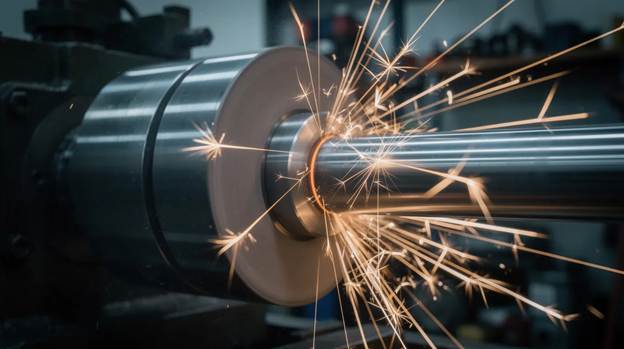
Key principles that govern every cylindrical grinding operation:
- Rotation – both the workpiece and the grinding wheel spin simultaneously; their relative speeds determine the cutting action and finish quality
- Feed – the wheel traverses longitudinally along the workpiece and advances radially in very small increments, often just a few microns per pass
- Speed – wheel peripheral speed, workpiece RPM, and traverse rate must be balanced to suit the material and the required finish
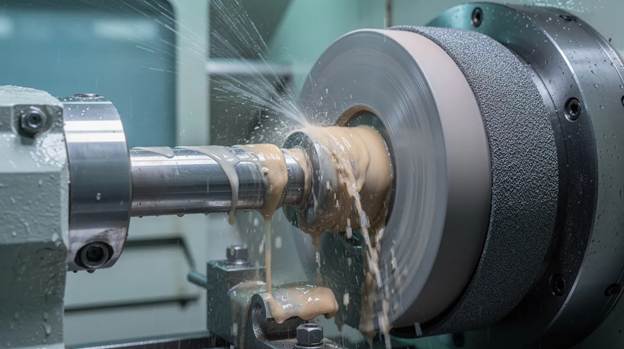
- Coolant – fluid is directed into the grinding zone to cool the contact area, lubricate the cut, and flush away swarf, preventing thermal damage
- Workholding – rigidity and alignment are critical; any run-out or deflection in the setup transfers directly into the finished part
Types of Cylindrical Grinding and When to Use Them
Different cylindrical grinding configurations suit different jobs. The choice depends on part geometry, tolerance requirements, material hardness, and production volume. Cylindrical grinding can produce components with complex geometries when the right setup and wheel profile are selected.
- External (OD) cylindrical grinding – the most common type. The grinding wheel contacts the outer surface of the workpiece, which is typically held between centres or in a chuck. This is the standard approach for shafts, axles, rollers, and bearing journals where roundness, straightness, and diameter accuracy are critical. Most of our work at Elmax falls into this category.
- Internal (ID) cylindrical grinding – used to machine bores and internal diameters on components such as bushings, sleeves, and hydraulic cylinder housings. The grinding wheel is smaller and enters the bore, which makes stiffness harder to maintain. Tolerances tend to be slightly wider than external grinding, but the process is essential when internal surfaces must be round, smooth, and precisely sized.
- Centreless cylindrical grinding – the workpiece is not held by centres or a chuck. Instead, it sits on a work-rest blade and is driven between a grinding wheel and a control wheel (also called a regulating wheel). This setup is ideal for high-volume production of pins, bars, rods, and other simple cylindrical shapes. Throughput is fast, but the method is less suitable when concentricity to other features matters.
- Special configurations – plunge grinding, taper grinding, and creep-feed grinding address stepped diameters, tapered shapes, or high material removal in fewer passes. These require purpose-dressed wheels and machines with appropriate traverse capability.
At Elmax Engineering, we primarily focus on cylindrical grinding between centres for precision components. When specialist centreless work or high-volume rod grinding is needed, we coordinate with trusted partners to ensure the job is completed to the same standard.
How Cylindrical Grinding Fits into Manchester Precision Engineering
Manchester and the surrounding area, including Stockport, have a deep-rooted heritage in engineering and manufacturing stretching back to the Industrial Revolution. The region has a skilled workforce experienced in demanding engineering sectors, and that expertise remains strong today. Elmax Engineering Ltd has been part of this local precision engineering ecosystem since 2003, contributing machining and finishing capability that supports OEMs across the North West.
Manchester’s precision engineering sector specializes in high-accuracy components, and firms in Manchester are known for fast setup and reliable delivery of components. Companies in this sector often provide a complete suite of manufacturing services, combining CNC machining with grinding and inspection under one roof. CNC milling produces complex shapes from flat materials, while 3-axis and 5-axis CNC machining are commonly used alongside cylindrical grinding to deliver complete parts.
Our typical workflow follows a logical sequence: CNC turning or CNC milling brings the component to near-net shape, heat treatment is applied if required, and then cylindrical grinding brings diameters to final size, form, and finish. High-quality CNC machining reduces manual errors and material waste during the roughing stages, so the grinding operation can focus on removing only the last few hundredths of a millimetre.
Manchester precision engineering underpins local supply chains where turning and milling alone cannot deliver the required accuracy. Industries served by Manchester’s precision engineers include food and medical sectors, plus construction and automotive. Local firms cater to demanding sectors like aerospace and automotive where failure is not an option. Precision engineering supports prototyping for various industries, and local precision engineering companies can manage prototype-to-production projects without needing to move work between multiple suppliers.
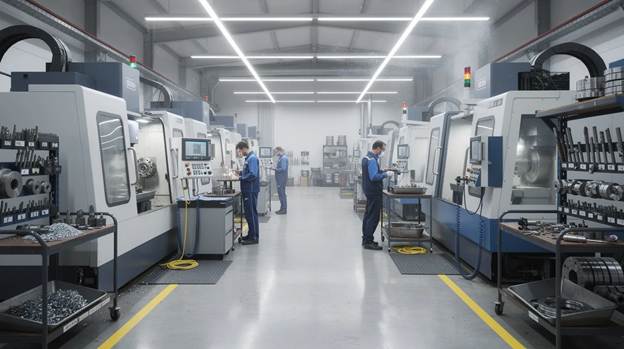
Here is how grinding integrates into real machining routes we handle regularly:
- Food-processing shafts – CNC turning to rough diameter, cylindrical grinding to achieve Ra 0.2–0.4 µm on bearing journals and seal surfaces, ensuring hygienic finish on stainless steel
- Hardened automotive pins – turned and heat-treated to 58–62 HRC, then ground to ±0.005 mm on diameter because turning tools cannot reliably cut material that hard
- Medical equipment spindles – CNC turned from 316 stainless, ground to tight roundness for vibration-free operation in precision instruments
- Construction fixings – keyway slotting combined with cylindrical grinding on the same component, both completed in-house before dispatch
- Urgent replacement shafts – our location in Stockport, south of Manchester city centre, allows fast collection and delivery across Greater Manchester and the North West for time-critical jobs
Inside the Process: From Rotating Grinding Wheel to Finished Component
Consistent results in cylindrical grinding come from controlling every stage of the cycle. Precision machining requires adherence to quality standards at each step, from setup through to final inspection.
- Pre-inspection – every pre-machined part is checked on arrival. We verify material hardness, existing dimensions, and any previous machining errors. Removing excess stock beforehand reduces grinding load and cycle time.
- Workholding setup – the workpiece is mounted between centres, held in a chuck, or placed on a mandrel depending on its geometry. Alignment is critical: any run-out in the setup becomes run-out on the finished part. We ensure centres are true and that the part is rigid enough to resist deflection under wheel pressure.
- Grinding wheel selection – the correct wheel specification makes or breaks the job. Abrasive type (aluminium oxide for softer steels, CBN for hardened materials), grit size (coarser for stock removal, finer for finish), hardness, bond, and structure are all selected to match the workpiece material. Cylindrical grinding can process materials like steel and titanium alloys, but each demands a different wheel and approach.
- Dressing the grinding wheel – before grinding begins, the wheel is dressed with a diamond tool to ensure it is concentric, sharp, and profiled correctly. Periodic re-dressing during the operation prevents glazing and maintains consistent cutting action.
- Feeds, speed, and passes – the wheel traverses along the workpiece length at a controlled speed while advancing radially in small increments. Rough passes remove the bulk of remaining stock. Intermediate passes refine the shape. Final spark-out passes-where the wheel runs without further radial infeed-eliminate residual deflection and spring-back, allowing us to achieve sub-0.01 mm tolerances and the required surface finish.
- Coolant management – coolant is essential for cooling the grinding zone, lubricating the contact area, and flushing swarf away from the wheel face. Poor coolant delivery causes burning, micro-cracks, or dimensional distortion from thermal expansion. We monitor flow rate and direction throughout the operation.
- In-process and final inspection – diameters are checked with calibrated micrometers and bore gauges during grinding. Surface finish is verified using profilometers. Temperature-controlled inspection ensures micron-level precision on critical dimensions. Manufacturing firms use coordinating measuring machines for quality control on complex parts, and we apply these methods to confirm that every component meets the customer drawing before it leaves the workshop.
Why Cylindrical Grinding Still Beats Alternatives
Every finishing process has its place. CNC turning is efficient for roughing and semi-finishing. Honing excels at internal bore finishing. Hard turning with CBN inserts can handle hardened steels. But when you need the combination of tight diameter tolerance, excellent roundness, and a smooth, consistent surface on a cylindrical component, grinding is unmatched.
- Accuracy – cylindrical grinding regularly achieves diameter tolerances of ±0.005 mm or better, with roundness errors controlled to 1–5 µm. Turning alone struggles to match this on hardened or long parts. Comparable precision grinding firms, such as B&B Precision in West Yorkshire, demonstrate similar capability with OD capacity up to 505 mm diameter and lengths to 2.8 metres, confirming that these tolerances are industry-standard for dedicated grinding operations across the UK.
- Surface integrity – a ground surface has fewer tool marks and virtually no chatter patterns compared with a turned finish. This directly improves bearing life, reduces friction, and lowers vibration. For sealing surfaces, the difference between Ra 1.6 µm (turned) and Ra 0.2 µm (ground) determines whether a seal works or leaks.
- Hard materials – through-hardened and case-hardened components above 55 HRC wear out turning inserts rapidly. A grinding wheel handles these materials efficiently, making grinding the default finishing method for hardened shafts, pins, and wear-resistant parts.
- Flexibility – the same cylindrical grinder can handle a one-off prototype in the morning and a batch of 500 identical parts in the afternoon. Setup is straightforward once proven, and repeatability holds across the entire run. This suits the way many OEMs order: prove one, then scale.
- Complementary methods – surface grinding and rotary grinding complement cylindrical grinding when components require both accurately ground diameters and precision-ground flat faces. Combining these methods on a single project gives complete geometric control.
Quality assurance minimizes defects in manufacturing processes, and grinding is where that final quality gate sits. This is why we continue to invest in cylindrical grinding capacity at Elmax.
Elmax Engineering’s Grinding Capabilities in Stockport, Manchester
Elmax Engineering Ltd is a precision engineering firm established in 2003, equipped with an in-house grinding department that supports our full range of CNC machining services. Our team combines expertise in turning, milling, grinding, and slotting to create finished components without relying on multiple subcontractors.
- Core services – CNC turning, CNC milling, cylindrical grinding, and keyway slotting. Grinding ties these operations together: parts are roughed and shaped by CNC, then ground to final size and finish. CNC machining can handle orders from one-off prototypes to large-scale production, and our grinding follows the same range.
- Grinding capacity – we handle common industrial diameters and lengths suitable for shafts, pins, rollers, and journals. Our kit covers parts from small precision pins to components several hundred millimetres in length, across a diverse range of geometries.
- Materials – carbon steels, stainless steels (304, 316), alloy steels such as EN24T, brass, aluminium alloys, and tool steels. Wheel selection is adjusted for each material: aluminium oxide for general-purpose steel work, CBN for hardened surfaces, open-structure wheels for stainless to prevent loading.
- Tolerances and finish – we target ±0.005 mm on diameter as standard, with tighter tolerances achievable for special jobs. Surface finish goals are typically Ra 0.2–0.4 µm on ground diameters. Quality assurance ensures products meet stringent specifications, and precision engineering firms employ ISO-certified processes such as ISO 9001 for quality assurance throughout the manufacturing process.
- Prototyping and production – prototyping can involve one-off components or small batches, and batch production can range from small to large quantities. Precision engineering firms are equipped to handle urgent repairs and production runs, and we offer rapid setup to keep lead times short.
- Complementary grinding – when customers need both accurately ground diameters and precision-ground flat faces, we combine cylindrical grinding with surface grinding through trusted partners where appropriate, ensuring the complete component is finished to specification.
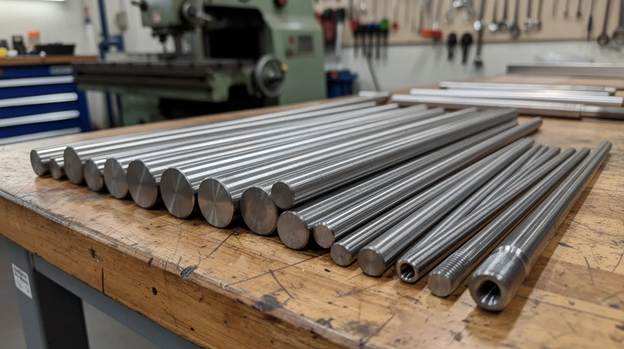
Applications: Where Cylindrical Grinding Delivers Real-World Value
Cylindrical grinding is used wherever rotating parts must run accurately and reliably over long service lives. CNC machining is used in industries like automotive and medical, and cylindrical grinding is the finishing step that makes those machined parts function correctly. Cylindrical grinding is used in industries like aerospace and medical devices alongside the sectors we serve daily.
- Automotive industry – cylindrical grinding is commonly used in automotive engine component manufacturing. Ground shafts, gearbox components, and hardened drive pins depend on diameter accuracy and roundness for smooth, quiet operation. Even small deviations in size or shape cause vibration, noise, and premature failure.
- Food processing – stainless steel mixer shafts, conveyor rollers, and agitator spindles require corrosion resistance and a smooth surface for hygiene. Cylindrical grinding delivers the finish needed to prevent bacterial trapping in surface irregularities, making products safe and equipment easy to clean.
- Medical and pharmaceutical equipment – high-quality components are essential for functionality in medical devices. Precision spindles, fixture components, and actuator shafts are ground to ensure repeatable assembly and minimal vibration. Surface finish and material integrity (no micro-cracks or burns) are non-negotiable in this sector.
- Construction and general engineering – hydraulic cylinder rods must seal correctly and resist wear in harsh environments. Precision bushes and pins used in structural joints require exact diameters for reliable fit. Cylindrical grinding ensures these parts perform under load and exposure to the elements.
- Cross-sector components – pump spindles, roller assemblies, and wear-resistant sleeves appear across multiple industries. In all cases, cylindrical grinding provides the dimensional accuracy and surface quality that keep these parts running. Where flat faces are also required on the same parts, surface grinding is applied alongside cylindrical work.
Integrating Cylindrical Grinding into Your Next Project
Bringing Elmax Engineering into a project early helps determine where cylindrical grinding, CNC turning, CNC milling, and keyway slotting fit best in the manufacturing route. Prototyping is essential for testing designs before mass production, and we can support that development from a single prototype through to ongoing batch production.
Our engineers review drawings, tolerances, and materials to advise where grinding operations will save time and reduce scrap compared with over-reliance on turning alone. Quality assurance processes improve customer satisfaction and trust, and we build inspection into every stage rather than relying on end-of-line checks alone.
Whether you are a manufacturer in Manchester or anywhere across the UK, we can advise on whether cylindrical, surface, or rotary grinding is the right approach for your specific components. Our attention to detail and focus on making parts right first time means fewer rejects and faster delivery.
To get started, here is what helps us provide an accurate quote quickly:
- Component drawings with tolerances and surface finish callouts clearly marked
- Material specification (grade, condition, hardness if heat-treated)
- Required tolerances on critical diameters, lengths, and form (roundness, cylindricity)
- Batch quantity and delivery schedule
- Any special requirements such as certificates, traceability, or specific inspection methods
Cylindrical grinding services is not a legacy process. It is a precision finishing step that no amount of CNC advancement has replaced. If your next project involves shafts, pins, journals, or any component where the last few microns matter, speak with our team in Stockport. We will review your requirements, confirm the best machining route, and deliver components that meet your specification-on time, every time.


Leave a comment